Science & Technology
Shio Pan Decoded: The Science Behind Every Step
By Moon, Yeju
March 23, 2026
Images
Article
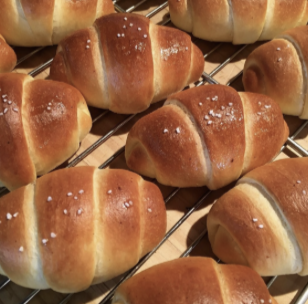
Most of the people who are reading this article might have eaten “Shio pan” or “salt butter rolls” before. The differences between the salt butter rolls and other breads are that they have a butter cave, which is an empty space inside the bread created by melting butter, and a pinch of salt on the top of the bread. The lightly crisp crust and pillowy, buttery interior of the bread bring us happiness and comfort. But it is not a fantasy that the taste of bread is. What actually creates this soft texture and rich flavor is mainly contributed to by the chemical reactions of its ingredients. Through the ingredients and process of baking Shio pan, we can understand their role in forming the bread and perceive the taste. Let’s go bake the Shio Pan together!
Steps to Make Shio Pan
1. The first step for every baker is to prepare the ingredients with the exact amount of them.
2. Second, put bread flour (250g), cake flour (50g), sugar (15g), salt (6g), and yeast (6g) into the bowl. The reason for using both bread flour and cake flour is for strength and extensibility. Because bread flour has 12-13% of gluten and cake flour has 7-9% of gluten, it provides less chewiness and greater holes in the bread. When adding sugar, salt, and yeast, it’s important to put them separately for proper fermentation. Then, mix those three ingredients first to coat the flour, and then incorporate all the ingredients in the bowl.
3. Third, pour cold milk (225g) into the bowl and knead it until the powder is invisible. Cold milk is intentionally used to slow down the speed of gluten formation and fermentation in order to maintain the crystals of butter.
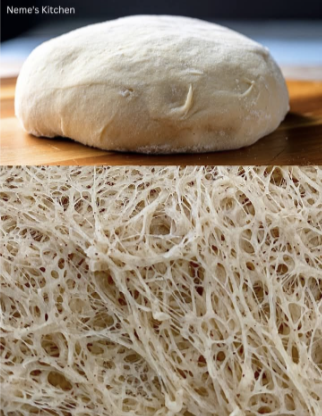
4. Fourth, add butter (15g) into the dough and knead it until the dough is smooth and elastic. When you can observe the gluten in the dough, your dough is ready. Gluten is a protein that comprises flour, mainly composed of glutenin, which provides elasticity, and gliadin, which contributes to extensibility. They form a network by sulfur atoms in some amino acids of the glutenin chain, which increases cysteine’s disulfide bonds.
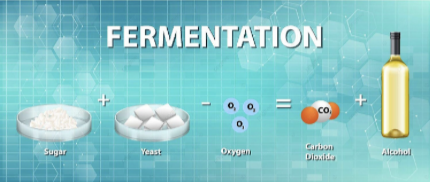
5. Fifth, arrange the dough and ferment it for 70 minutes at a temperature of 30 degrees. Yeast, an organic leavener, mainly contributes to fermentation. 10th graders might be familiar with the chemical equation of “NaHCO3+ C3H5COOHNaC3H5COO+H2CO3”, which we recently learned in general chemistry class. Although the reaction of fermentation is slightly different from this, both produces CO2 , which is trapped in a gluten network that traps gases to make the bread rise in a light, airy texture.
6. Sixth, when the dough rises to about 2.5 times its size, divide it into 8 portions.
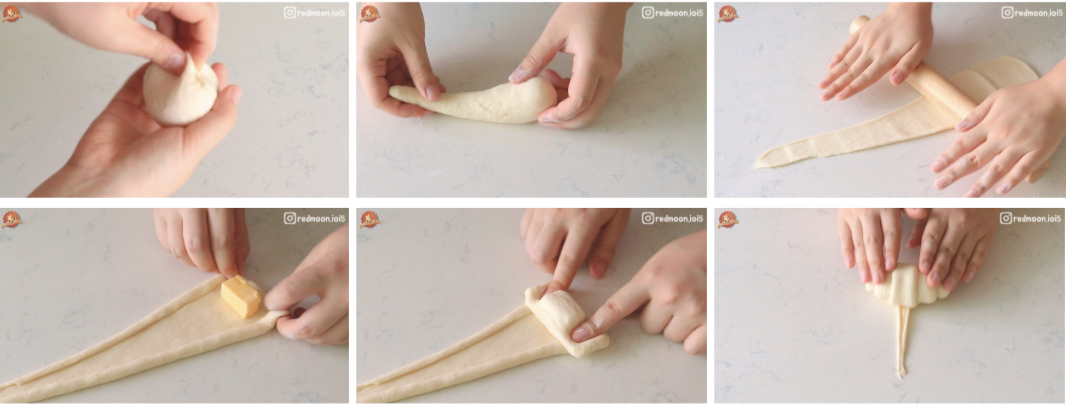
7. Seventh, round the divided dough, and roll it out to form a cone shape.
8. Eighth, have a bench time for 20 minutes to realign broken gluten.
9. After the bench time, roll the dough with a rolling pin in an inverted triangle shape while slightly pulling it. Next, put unsalted butter in the form of a 15g stick to make a butter hole inside and roll it.
10. Do the final fermentation for 50 minutes until the dough doubles.
11. Before baking, brush milk and sprinkle one pinch of salt on the top. Bake in the 200 degrees preheated oven for 13 to 15 minutes. To make the bread additionally moist, spray water once or twice before baking.
12. After baking, before moving them to the cooling net, leave them for a while to make flown out butter to absorb into the bread.
When you enjoy the bread, your brain will perceive the taste and smell by the information collected by your eyes, nose, and tongue!
Each of the ingredients used to make Shio pan contributes to conveying the taste and texture of the bread, which we perceive from our eyes and tongue to our brains. This is just one example of how general school subjects, such as biology, chemistry, and physics, are applied directly to real life, not just principled acquisitions. Any other students can link their interests to science, so try questioning scientifically about your personal interests.
Citation
CAKE GALLERY. (2025, October 17). Gluten structure in bread making. Facebook. Retrieved March 14, 2026, from https://www.facebook.com/groups/111491717466117/posts/1161189952496283/
Calorie restaurant칼로리 식당. (2023, March 1). 가장 이상적인 소금빵 만들기(반죽기버전)/탈지분유없이/Salted Butter Roll Bread/塩パン [Video]. YouTube. https://www.youtube.com/watch?v=zENUpb3NaDw
Easyonlinebakinglessons. (2025, January 26). Science of baking. Caroline’s Easy Baking Lessons. https://www.easyonlinebakinglessons.com/science-of-baking-understanding-how-ingredients-work/#:~:text=Eggs%20provide%20protein%2C%20fat%20&%20moisture,all%20producing%20lighter%20baked%20goods
Fox, M. (2026, March 13). The difference between cake flour, bread flour, pastry flour, and All-Purpose flour. Real Simple. https://www.realsimple.com/food-recipes/cooking-tips-techniques/baking/difference-between-flours
Nolin, K. (2024, February 20). Gluten’s complex chemistry contributes to delicious baked goods. Scientific American. https://www.scientificamerican.com/article/glutens-complex-chemistry-contributes-to-delicious-baked-goods
Pooja. (2025, November 27). The best salt bread (Shio pan) recipe – Buttery Japanese Rolls - the Global Vegetarian. The Global Vegetarian. https://theglobalvegetarian.com/recipes/salt-bread/
Rose, D., & Rose, D. (2024, July 1). The science of baking: understanding the role of each ingredient. Fine Sconehenge Baking Co. https://www.finesconehengebakingco.com/the-science-of-baking-understanding-the-role-of-each-ingredient
Smith, D. V., & Margolskee, R. F. (2024, February 20). Making sense of taste. Scientific American. https://www.scientificamerican.com/article/making-sense-of-taste-2006-09
The Culinary Institute of America. (n.d.). Advanced baking principles. BAKING AND PASTRY. https://nscpolteksby.ac.id/ebook/files/Ebook/Hospitality/Mastering%20the%20Art%20and%20Craft-Wiley/Chapter%20Four%20Advanced%20baking%20principles.pdf
Van Meyel, O. (2019, November 18). Yeast Fermentation in Bread – How Does it Work? Lesaffre AU. https://lesaffre.com.au/news/yeast-fermentation-in-bread#:~:text=Yeast%20is%20a%20living%20organism,and%20baked%20products%20are%20denser
yayimage. (n.d.). Alcoholic Fermentation Chemical Equation Design Picture Learning Vector. Pngtree. https://pngtree.com/freepng/alcoholic-fermentation-chemical-equation-design-picture-learning-vector_10669148.html
나는야 베이킹유튜바 : 네이버 블로그. (n.d.). https://blog.naver.com/mjm8673/222859833517
황보희정. (2022, April 9). 나 소금빵 좋아하네. Allure Korea. https://www.allurekorea.com/2022/04/09/%EB%82%98-%EC%86%8C%EA%B8%88%EB%B9%B5-%EC%A2%8B%EC%95%84%ED%95%98%EB%84%A4/